K Enerji
Home › Energy Storage
02 · Energy storage

LFP battery cells and energy storage systems

One LFP technology, scaled to your needs, from a portable module up to a full container. It works hand in hand with hybrid solar and wind power systems.

Why LFP?

Safe, long-lasting and scalable energy storage

The biggest challenge with renewable energy is continuity: the sun sets at night and the wind does not always blow. An energy storage system holds the energy you generate in batteries so that it is available whenever you need it. For this job, K Enerji uses lithium iron phosphate chemistry (LiFePO4, or LFP for short).

LFP stands out for its thermal stability. With no cobalt or nickel in the cathode, it has a low tendency towards thermal runaway, which keeps the risk of fire and flare-ups to a minimum. It also lasts far longer: 6,000 cycles or more, compared with 300–600 cycles for lead-acid batteries. According to the manufacturer's test data, the cell reaches 11,000 cycles at 80% depth of discharge and, at one cycle a day, still retains 80% state of health (SOH) at the end of year 10.

The same technology from cell to container

The system grows in modular steps. A single 3.2 V, 100 Ah cell stores 320 Wh. Fifteen cells in series make a 48 V, 4.8 kWh battery module; sixteen cells in series make a 51.2 V, 5.12 kWh module. In LV systems, up to 15 modules can be connected in parallel for 72 / 76.8 kWh; in HV systems, the modules are connected in series. Larger requirements are met with 261 kWh cabinet-type and 5,016 kWh containerised energy storage systems.

Monitored and protected

Every pack runs with a battery management system (BMS) that tracks voltage and temperature cell by cell. Power and energy management (PCS / EMS) handles grid-connected, island-mode and hybrid operation, and the system can be monitored remotely via 4G, a web interface and SCADA. Early-detection sensors and an automatic aerosol fire suppression system provide multi-layer safety for critical facilities.

To see which generation systems this storage infrastructure works with, visit our hybrid renewable energy systems page.
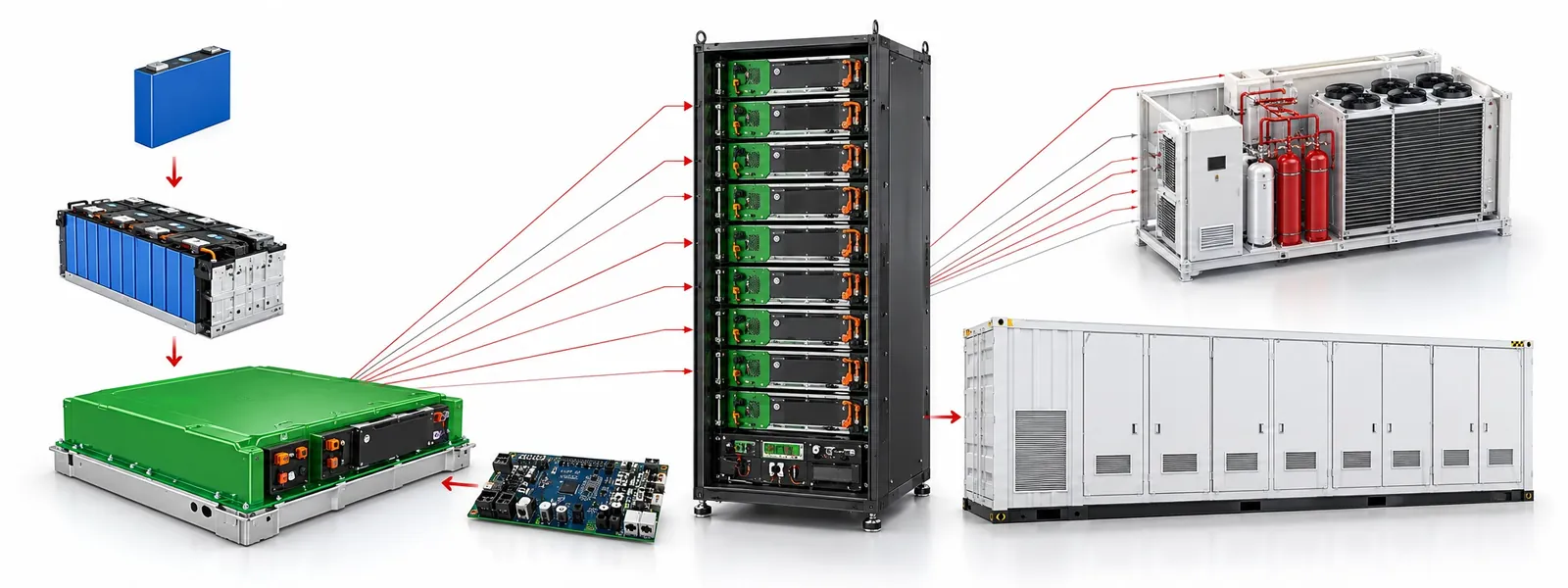
Battery cell, battery modules, battery pack, battery cabinet and containerised energy storage unit
  • Lithium-ion batteries are used in integrated energy storage systems that can store energy, however it was generated.
  • Their advantages include high energy density, a long cycle life and a long shelf life (the time they can stand idle without discharging).
  • An energy storage system stores energy in batteries so that it can be used later.
  • For reliable, trouble-free operation, energy storage systems are installed together with control and management systems.
Battery architecture

LFP cell technology and battery architecture

From a 100 Ah cell to module and system: a modular, scalable design

CELL LiFePO4 · 3.2 V · 100 Ah 3.2 V × 100 Ah = 320 Wh MODULE 48 V: 15 cells in series51.2 V: 16 in series 4.8 kWh · 5.12 kWh LV SYSTEM(PARALLEL) 48 V / 51.2 V LVmodules in parallel up to 15 modules72 / 76.8 kWh or HV SYSTEM(SERIES) 51.2 V HV modulesconnected in series n × 51.2 Vn × 5.12 kWh

Cell specifications (314 Ah prismatic cell)

ParameterValue
Chemistry / electrolyteLiFePO4 (LFP) · Semi-solid
Format / casingPrismatic · Aluminium
Nominal / charge voltage3.20 V / 3.60 V
Deep-discharge cut-off voltage2.90 V
Capacity / energy314 Ah / 1,004.8 Wh
Internal resistance0.29 mΩ
Dimensions / weight173 × 71 × 207 mm / 5.4 kg

The case for LFP chemistry

  • Thermal stability: The cobalt- and nickel-free cathode has a low tendency towards thermal runaway, keeping the risk of fire and flare-ups to a minimum.
  • Long life: 6,000 cycles or more, compared with 300–600 cycles for lead-acid batteries.
  • Light and compact: ~180 Wh/kg energy density; around 6 times lighter than lead-acid and around 4 times smaller in volume.
  • Stable voltage: Voltage stays steady throughout discharge, which makes it ideal for sensitive communications and security equipment.
  • Environmentally friendly: Free of heavy metals and toxic elements, and easy to recycle.
Performance

Cycle life and performance data

State of health (SOH) over the years, based on the cell manufacturer's test data

SOH (%) vs. year (25–30 °C)

10090807060 02468101214161820 0.5C · 1 cycle per day 1C · 1 cycle per day 0.5C · 2 cycles per day

The manufacturer has not published data (below 70% SOH) beyond the point where the curves end.

11,000

test cycles

Tested cycle life · 80% DOD · to 70% SOH

80%

SOH

At the end of year 10 · 0.5C · 1 cycle per day

≥94%

energy efficiency

Cell energy efficiency · at 0.5C

6,000–15,000

expected cycles

Expected cycle range, depending on operating conditions

Lifetime figures apply at a cell temperature of 25 °C, at the recommended DOD and with an average SOC of ≤50% during idle periods. To protect battery health, we recommend ending discharge at no lower than 20% SOC.

Safety

Battery management and multi-layer safety

Monitored, protected and uninterrupted power for critical facilities

1

Battery Management System (BMS)

  • Slave BMS: Cell-level voltage and temperature monitoring on every pack/rack
  • Active balancing: Balances the cells against each other to prevent capacity loss
  • Master BMS: Calculates system SoC/SoH; when necessary, it stops charging, cuts discharge and isolates the system
  • Protection: Over/under-voltage, overcurrent, short-circuit, temperature and insulation monitoring
2

Power and Energy Management (PCS / EMS)

  • Operating modes: Grid-connected, off-grid (island mode) and hybrid (solar + wind + battery + generator)
  • Bidirectional PCS: Uninterrupted energy flow between battery, load and grid; black start option
  • EMS: Charge/discharge prioritisation, load management and renewable integration
  • Remote monitoring: 4G wireless, web interface and SCADA integration; alarm and event logs
3

Safety and Resilience

  • Early detection: Temperature, smoke and gas sensors at cell, module and cabinet level
  • Automatic suppression: Hot aerosol system · 67 g/m³ · 7–36 s discharge · 12-year service life
  • Electrical protection: DC/AC emergency breakers, external emergency stop button, earthing
  • Site conditions: IP65 · C5 corrosion-class coating · non-combustible stone wool insulation · −20 / +60 °C
Standards: IEC 62619 (cell) · IEC 62477 (PCS) · IEC 62933 (system) · UL 9540 · IEC 61000 / EN 55032 (EMC) · compliant with the TEİAŞ grid code
Product range

Battery product options and technical data

Feature100 Ah Battery Modules (LV / HV)Cabinet-Type ESSContainerised ESS
Typical useMobile systems, trailers, field equipmentHybrid power systems for military units / border outpostsCentral bases, high-capacity facilities
Energy capacity4.8 kWh (48 V) · 5.12 kWh (51.2 V) per module261 kWh (522 kWh optional)5,016 kWh
Nominal voltage48 V / 51.2 V832 V1,331 V
AC outputHybrid inverterHybrid inverter 50–80 kVA (MPPT) or PCS 125–250 kVAExternal PCS / MV transformer skid
C-rateLV: 1C · HV: 0.5C0.5C / 1C0.5C / 1C
ExpansionLV: up to 15 in parallel · HV: in seriesCabinets in parallelMultiple containers (MWh scale)
CoolingPassiveAir or liquidLiquid cooling (120 kW)
EnclosureMetal casing · rack / wall-mountedDouble-walled, stone wool insulatedISO 20 ft, IP65, double-walled insulation
Monitoring / communicationRS232 / RS485 / CANRemote access + EMS4G + SCADA / EMS, RS485, CAN, Ethernet
Design cycle life6,000 cycles> 6,000 cycles> 8,000 cycles

Warranty

5-year system · 10-year cell warranty (cell warranty terms depend on the usage profile and number of cycles)

Mobile solution

Mobile energy storage from 1 kVA to 1 MVA on a road-registered trailer, running silently in place of a generator

Maintenance

The cells are maintenance-free; we recommend two periodic inspections a year (air conditioning, cleaning, measurements)

Battery modules

LFP battery modules with 100 Ah cells

Plug-and-play modules for critical loads: expand LV systems in parallel and HV systems in series

100 Ah

LiFePO4 cell capacity

6,000

design cycle life

15

LV modules in parallel (maximum)

Applications

  • Radio, relay and communications equipment
  • Thermal cameras, radar and surveillance systems
  • Lighting and perimeter security
  • Backup power and UPS for towers / border outposts
Feature48 V Module51.2 V Module (LV)51.2 V Module (HV)
Cell configuration15s · 100 Ah16s · 100 Ah16s · 100 Ah
Energy (V × Ah)48 V × 100 Ah = 4.8 kWh51.2 V × 100 Ah = 5.12 kWh51.2 V × 100 Ah = 5.12 kWh
C-rate1C1C0.5C
Std. / max. charge-discharge current100 A / 100 A100 A / 100 A50 A / 50 A
Operating voltage43.5 – 54.75 V46.4 – 58.4 V46.4 – 58.4 V
Charge voltage54.0 – 54.75 V57.6 – 58.4 V57.6 – 58.4 V
ConnectionParallel · up to 15 unitsParallel · up to 15 unitsSeries · high-voltage system
DisplayDepending on versionYesNo
CommunicationRS232 / RS485 / CANRS232 / RS485 / CANRS232 / RS485 / CAN
MountingRack or wall-mountedRack-mountedSeries tower / rack
Weight45 kg47 kg47 kg
Dimensions (W×D×H, mm)435 × 436 × 158430 × 436 × 158437 × 435 × 159
Common specifications: Charge 0 ~ 60 °C / Discharge −10 ~ 60 °C · Humidity 5–95% · Self-discharge 2% per month · CE · 5-year warranty
How many panels?Free solar calculator